|
Home
|
Sep 1, 2026
This week’s themeWords made with animal parts This week’s words dogleg stickybeak moth-wing griffonage cowhearted 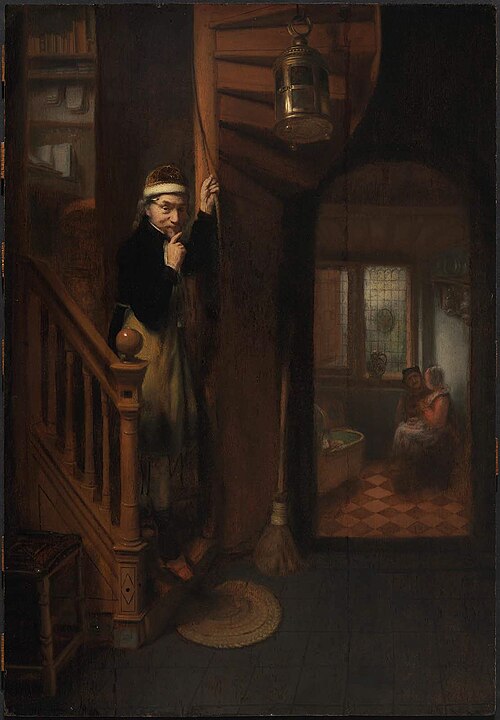
The Eavesdropper, 1655
Art: Nicolaes Maes Wordsmith Games
A.Word.A.Day
with Anu Gargstickybeak
PRONUNCIATION:
(STIK-ee-beek)

MEANING:
ETYMOLOGY:
From stick, from Old English stician (to pierce or thrust) + beak (slang
for a human nose). Earliest documented use: 1914.
NOTES:
If you stick your nose where it doesn’t belong, you might expect
to be called a stickynose. English took the more colorful route and gave
us stickybeak, using beak as slang for the human nose. Its two crisp k
sounds make it doubly satisfying. The term is more common in Australia
and New Zealand, but judging by the vocabulary, there is no shortage of
nosy people anywhere: English also has nosy parker,
prodnose, busybody,
quidnunc, and
yenta.
USAGE:
“Well, the next day Maureen said she was going over to say hello. To
tell you the truth, Mo wanted to have a bit of a stickybeak, curious
to see how they were settling in.” Yasmine Gooneratne; A Change of Skies; Picador Australia; 1991. “McIntire County was a bona fide mob of stickybeaks putting their noses where they didn’t belong.” Winter Austin; Sins of the Father; Crimson Romance; 2016. A THOUGHT FOR TODAY:
The less a statesman amounts to, the more he loves the flag. -Kin Hubbard,
humorist (1 Sep 1868-1930)
|
|
Subscriber Services
Awards | Stats | Links | Privacy Policy
Contribute | Advertise
Awards | Stats | Links | Privacy Policy
Contribute | Advertise
© 1994-2026 Wordsmith